
A.J. Davidoff LLC
Rock Solid Defense for Accidental Pond Drowning
Andrew J. Davidoff, Ph.D., P.G., Geology, Geophysics, and Earth Science Expert
Case Summary: The incident in question involves the drowning death of an older adult found in a pond behind the family residence. The discovery was made by a pond management company employee, who initially mistook the body for a floating object. The police treated the investigation as a potential homicide. An autopsy later revealed that the cause of death was drowning, and the incident was ruled accidental. The deceased was visiting their family, whose residence opened directly onto the pond.
The primary issue revolves around whether the rocks surrounding the pond contributed to the incident. The plaintiff claimed that the rocks were slippery, leading to the deceased’s fall, head injury, and subsequent drowning. The scope of the requested work was to scientifically analyze the rocks to determine if they were indeed slippery and thus contributed to the accident.
Expert Analysis: The analysis began with a thorough review of case-specific documents, including the summons and complaint, various discovery documents, police investigation reports, crime scene photographs, and expert reports from the plaintiff.
Crime scene photographs were of sufficient resolution to conduct a detailed analysis of the properties of the rocks in the area where the victim fell. The analysis focused on evaluating the photographs for the structure, texture, and color of the rocks.
Careful inspection of the photographs under high magnification indicated the rocks had a rugose or rough texture. Many of the rocks also displayed faint small-scale layering. The small-scale layering is strong evidence of sedimentary deposition, while the rough texture is an indicator of sand-size grains. The reddish-brown color of the rocks is an indicator of hematite cement, common in sandstones.
The rocks in the photo below are sandstones, similar to those around the pond discussed. They display a rough texture, distinct sedimentary layering, and reddish-brown coloring indicative of hematite cement.
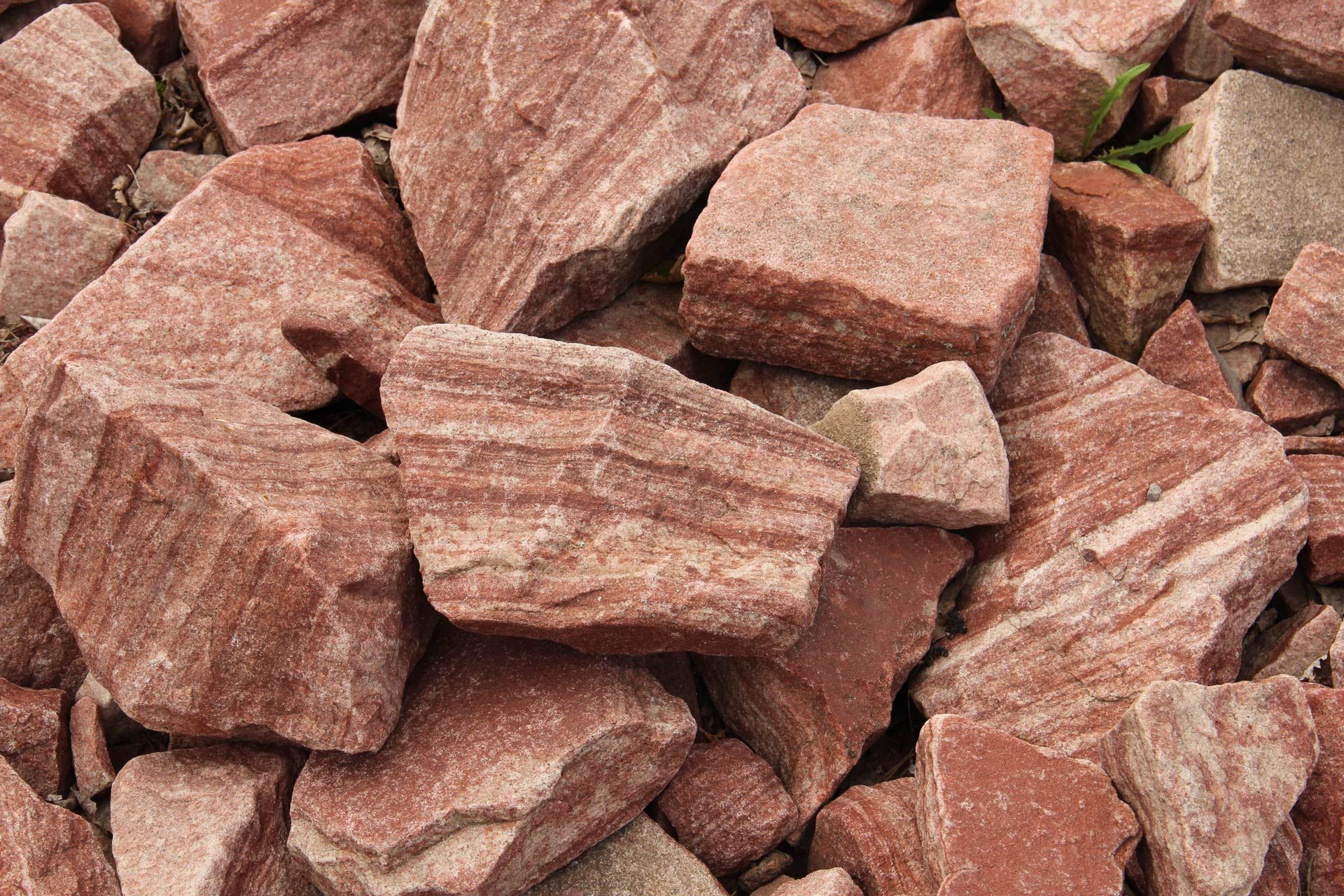
Based on the above analysis, the rocks in the vicinity of the pond were identified as medium- to coarse-grained sandstone. The presence of hematite cement and the visible sedimentary structures further confirmed this identification.
Anything with a coefficient of friction greater than 0.5 is considered slip resistant. Sandstones are documented to have a coefficient of friction between 0.71 and 0.85. The coefficient of sandstones is significantly greater than 0.5, indicating that they are slip resistant.
Based on the scientific analysis, it was concluded that the rocks around the pond were not slippery, and thus, did not contribute to the deceased’s fall and subsequent drowning. The incident was likely a tragic accident unrelated to the condition of the rocks.
Result: The case was resolved prior to trial.
Contact A.J. Davidoff LLC at
(281) 771-8916 for your geologic, geophysical, and subsurface expert needs or visit
www.forensicDJS.com for additional areas of expertise.